Gurpreet Singh
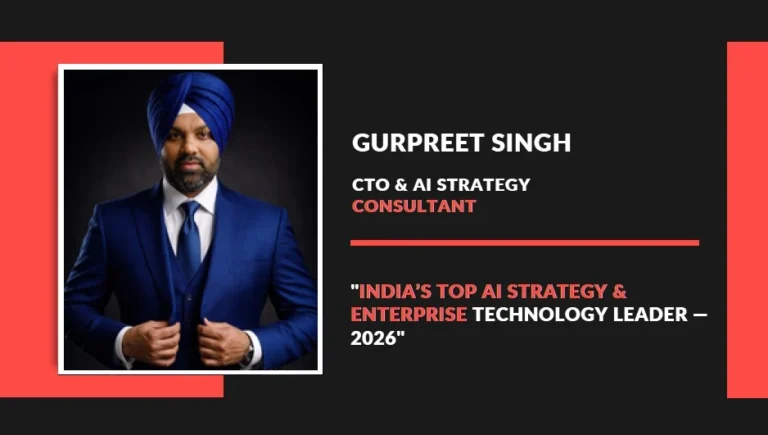
India’s Top AI Strategy & Enterprise Technology Leader – 2026
Turning Technology Into Measurable Business Impact
Artificial intelligence has become one of the most talked-about technologies in the world. Yet for many organizations, the biggest challenge is not understanding their potential. It is knowing how to turn that potential into measurable business results. Between ambitious ideas and successful implementation lies a gap that only a few technology leaders know how to bridge. Gurpreet Singh has built his career by helping organizations close that gap.
As a CTO and AI Strategy Consultant, Gurpreet Singh has worked across industries including healthcare, aviation, telecommunications, e-commerce, climate technology, enterprise platforms, and the public sector. Throughout this journey, he has developed a reputation for looking beyond technology trends to focus on what truly matters: solving business problems, improving operations, and helping organizations create sustainable value.
Rather than viewing artificial intelligence as a standalone solution, he believes it should be part of a much larger transformation strategy. His work centers on helping leadership teams identify practical opportunities, build responsible operating models, and create systems that deliver long-term impact. This balanced approach has positioned him as a trusted advisor for organizations navigating digital transformation in an increasingly complex business environment.
His journey reflects years of learning across startups and large enterprises, where every challenge became an opportunity to understand how technology, leadership, and business strategy intersect. Those experiences continue to shape his work today.
“I have always believed that technology becomes valuable only when it solves meaningful business problems,” he says. “The goal is not simply to introduce AI. It is to create outcomes that organizations can measure, sustain, and build upon.”
Building a Foundation Through Experience
Every leader’s perspective is shaped by the environments that influence them early in life. For Gurpreet Singh, those influences began in Delhi, where he grew up in a middle-class family that placed great importance on education, discipline, and responsibility.
His father served with Northern Railways as a Central Government employee, while his mother managed the family with unwavering dedication. Together, they created an environment where consistency mattered more than shortcuts and where success was measured by contribution rather than recognition.
These values stayed with him as he entered the technology industry. Early roles exposed him to enterprise systems, operational challenges, customer expectations, and rapidly changing business environments. Working across diverse sectors helped him realize that technology is rarely the biggest challenge. Instead, organizations often struggle to align technology with business priorities, people, and long-term goals.
Experience in both multinational enterprises and fast-growing startups further broadened his perspective. Large organizations taught him the importance of governance, structured execution, scalability, and stakeholder alignment. Startups introduced him to agility, ownership, and the ability to deliver results despite limited resources.
Together, these experiences helped shape a leadership philosophy that combines strategic thinking with practical execution.
Leadership Rooted in Clarity and Trust
Leadership, in Gurpreet Singh’s view, is less about directing teams and more about creating clarity. Whether advising executives or leading transformation initiatives, he believes people perform best when they understand both the purpose of change and the outcomes they are working toward.
His management style emphasizes collaboration, transparency, and accountability. Rather than imposing technology solutions, he works closely with leadership teams, business stakeholders, engineers, and product managers to develop strategies that everyone can support.
Years of working across industries have reinforced one important lesson: successful transformation depends as much on people as it does on technology.
“Transformation is not a presentation or a roadmap,” he explains. “It is a change journey that requires trust, patience, systems thinking, and the ability to translate between business ambition and technical reality.”
This philosophy allows him to serve as a bridge between executives focused on business growth and technical teams responsible for implementation. By translating strategic objectives into practical execution plans, he helps organizations move with confidence instead of uncertainty.
His approach also encourages continuous learning. Technology evolves rapidly, and organizations must remain adaptable without losing sight of long-term objectives. Building teams that embrace learning, collaboration, and responsible innovation has become one of the defining characteristics of his leadership.
Driving Innovation With Purpose
Innovation often fails when organizations begin with technology instead of business needs. Gurpreet Singh believes the opposite approach delivers stronger results.
Instead of asking which AI tool should be implemented, he begins by asking what business problem needs to be solved. This simple shift changes the entire direction of transformation efforts.
His consulting engagements typically start with understanding organizational objectives, operational workflows, data maturity, governance structures, and customer expectations. Only after gaining this understanding does technology become part of the conversation.
This outcome-first strategy has helped organizations avoid costly experimentation while identifying high-value opportunities where artificial intelligence can deliver measurable improvements.
“The future belongs to organizations that combine strategic clarity with execution discipline,” he says. “AI should never be adopted simply because it is available. It should be implemented because it creates measurable value.”
His innovation framework extends well beyond technology selection. It includes data readiness, operating models, governance, product thinking, change management, user adoption, and long-term scalability. Each component plays an important role in ensuring AI initiatives continue creating value long after deployment.
Rather than encouraging organizations to pursue large, complex transformation programs immediately, he often recommends focused pilot initiatives. These pilots demonstrate measurable business value while allowing organizations to build confidence before expanding implementation.
This measured approach reduces risk while creating momentum for broader digital transformation.
Across industries, he has supported initiatives involving healthcare operations, climate data platforms, enterprise modernization, intelligent workflows, customer experience improvements, and decision support systems. Despite their differences, these projects share one common objective: helping organizations make better decisions through practical, responsible technology adoption.
Closing the Gap Between Vision and Execution
One of the defining themes throughout Gurpreet Singh’s career has been helping organizations overcome the gap between ambition and execution.
Many businesses recognize the opportunities presented by artificial intelligence, automation, and digital platforms. Yet enthusiasm alone rarely produces successful transformation.
According to Gurpreet Singh, organizations often face familiar obstacles, including fragmented data, legacy technology, unclear business priorities, governance challenges, and limited internal capabilities. These issues cannot be solved by introducing another technology platform alone.
Instead, they require structured planning, leadership alignment, clear ownership, and disciplined execution.
His methodology focuses on identifying business outcomes first, evaluating organizational readiness second, and implementing technology only when the supporting foundation is in place. This systematic approach reduces uncertainty while increasing the likelihood of long-term success.
By combining strategic planning with hands-on execution, Gurpreet Singh continues to help organizations move beyond experimentation and toward meaningful transformation that delivers measurable business results.