Jean-François Hocquette
Director, INRAE
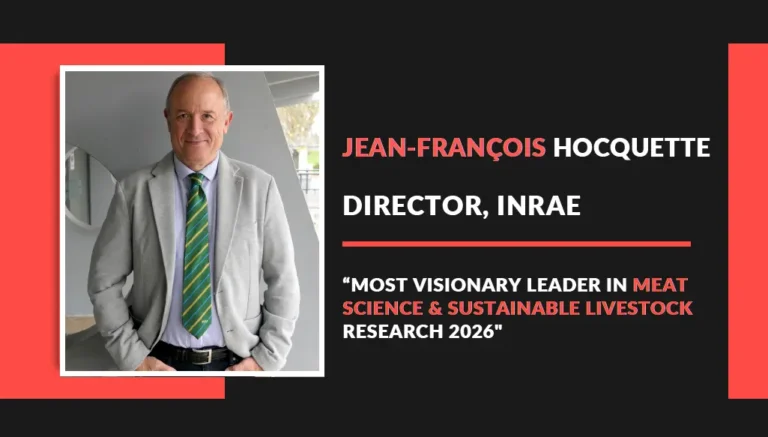
Jean-François Hocquette: Advancing Animal Science Through Research, Collaboration, and a Broader Vision of Quality
In the evolving world of animal science, meaningful progress depends on research that looks beyond a single question. For Jean-François Hocquette, Director of Exceptional Class Research at INRAE, that belief has shaped a career built around scientific research, international cooperation, consumer understanding, and practical impact. His work has addressed some of the most important questions surrounding animal production, meat quality, sustainability, and the future of food.
Employed by INRAE, the French National Institute of Research on Food, Agriculture and Environment, and President of the French Association for Animal Production, Hocquette has taken on a wide range of leadership and research responsibilities throughout his career. His professional journey has included leading a research team, directing the Herbivore Research Unit, contributing to INRAE’s international relations, and serving as President of the Cattle commission of the European Federation of Animal Science (EAAP). He has also represented France in international scientific organizations and evaluated approximately 70 research units across research institutes, universities, and higher education institutions when he has been working for the High Council for Evaluation of Research and Higher Education.
Leadership Built Around Scientific Responsibility
Hocquette’s leadership journey has developed through responsibility, collaboration, and service to the wider scientific community. Rather than viewing leadership as a position alone, his career reflects an approach centered on creating opportunities for research, connecting experts, and bringing scientific knowledge into wider discussions.
International engagement has been a major part of that journey. He France in organizations including the European Federation of Animal Sciences (EAAP) and the International Meat Research 3G Foundation. His ability to connect scientific communities has also been evident through his involvement in major international meetings.
Among the most significant milestones was his role in organizing the World Congress of Animal Science in 2023 (i.e. the annual EAAP meeting combined with the congress of the World Association for Animal Production). The event brought together more than 2,200 delegates from around 66 countries and represented a major achievement in his professional career. Earlier initiatives included international workshops and conferences that brought together scientists, industry professionals, and researchers from numerous countries.
This experience has reinforced a leadership philosophy based on cooperation. Scientific progress, in his view, benefits from bringing different disciplines, institutions, countries, and perspectives into the same conversation.
Looking Beyond Traditional Boundaries
One of Hocquette’s most notable areas of research has been the debate surrounding cultured meat. As an expert in animal production and meat production, he was increasingly asked by policymakers and journalists to provide scientific perspectives on this emerging technology.
Instead of approaching the subject from a narrow industry perspective, he focused on understanding how consumers viewed cultured meat. Together with colleagues, he conducted an international consumer survey covering several European countries, Brazil, China, and countries across Africa and the Arab world. With more than 20,000 respondents, the research became the largest international survey of its kind on consumer perceptions of cultured meat at the time, as described in the questionnaire.
The work also placed Hocquette among the main researchers publishing scientific research specifically on cultured meat. His approach demonstrated the value of combining scientific research with consumer and social perspectives when examining new technologies.
The One Quality Approach
The future of animal production presents complex questions involving ethics, environmental concerns, nutrition, consumer expectations, and production systems. Hocquette has responded to these challenges by developing research around the multifaceted nature of quality.
Together with colleagues, he developed the “One Quality” framework. Initially focused on eating quality, the concept was later expanded through the EU-funded INTAQT project. The framework considers quality through several dimensions, including nutrition, taste, ethics, and environmental attributes.
Rather than treating these factors separately, the approach uses a multiscoring system to create a broader assessment of the overall quality of animal products and their production systems.
This reflects an important element of Hocquette’s research philosophy: quality cannot be understood through one measurement alone. Consumers, producers, researchers, and society may all view quality differently, making a broader framework essential for meaningful assessment.
Turning Research Into Industry Impact
For Hocquette, research gains greater value when it can move beyond academic publications and contribute to real-world systems. His work on meat quality provides a strong example.
Building on international collaboration and approaches developed in Australia, he contributed to the development of a European meat grading system similar to the Australian MSA approach to predict beef eating quality by combining tenderness, flavor, juiciness and overall liking. The work involved French meat companies, European partners, PhD students, and international collaborators.
The research contributed to the launch of the Meat 3G, or Global Guaranteed Grading, system at the European level. It also supported the development of OR ROUGE, a premium beef brand launched by Beauvallet. The research has further influenced official guidelines of the United Nations Economic Commission for Europe concerning meat trade. INRAE also recognized the work for its socioeconomic impacts through the ASIRPA method.
The continuing connection with industry remains important. Hocquette regularly presents research findings to breeders, butchers, processors, restaurateurs, distributors, consumers, and other stakeholders within the beef sector. This ongoing exchange helps ensure that scientific findings remain connected to practical needs.
A Career Marked by Recognition
Hocquette’s research record includes more than 300 scientific articles, including highly cited research on cultured meat and review work covering areas such as beef health value, intramuscular characteristics, and approaches for predicting eating quality.
His work has also received international recognition. Among the honors listed in his profile are the American Society of Animal Science Meats Research Award in 2021 and the Animal Growth and Development Award in 2014, along with the American Meat Science Association Distinguished Research Award in 2026. He also received the EAAP Distinguished Service Award in 2025 and other scientist and lifetime achievement recognitions. He is a member of the French Academy of Agriculture and the French Meat Academy.
These milestones reflect a long-term contribution to animal science, with research spanning scientific discovery, international cooperation, industry application, and public discussion.
Collaboration as a Driver of Innovation
International partnerships have played a central role in advancing Hocquette’s work. His collaborations, particularly with researchers and organizations in Australia, provided access to innovative methods for predicting meat quality.
For more than 15 years, he has contributed on behalf of INRAE to the development of the Meat 3G system. The initiative has involved the French Livestock Institute, Beauvallet, Bordeaux Sciences Agro, ISARA, and international collaborators, especially from Australia and Poland.
Such partnerships demonstrate how innovation can emerge when research institutions, businesses, universities, and international experts work toward shared objectives.
Shaping the Future of Animal Agriculture
Looking ahead, Hocquette aims to give greater visibility to scientists working across different disciplines and contributing to a balanced understanding of the future of animal agriculture. He also intends to support the beef sector through wider implementation and promotion of the 3G method.
The objective is twofold: improving consumer satisfaction through better prediction of beef quality while supporting decent incomes for livestock farmers.
His broader perspective extends beyond production methods. He emphasizes that the future of meat must be understood through scientific, technological, social, cultural, and consumer perspectives. Meat is connected not only with nutrition, but also with pleasure, culture, tradition, and social connection.
That holistic view captures the foundation of Hocquette’s work. His career demonstrates how scientific leadership can connect research with industry, consumers, policymakers, and society. By encouraging collaboration across disciplines and countries, his work continues to contribute to a more complete understanding of animal production and the changing expectations surrounding food.
For Jean-François Hocquette, the future of animal science is not defined by one technology, one discipline, or one point of view. It is shaped by the ability to bring different forms of knowledge together and use research to create practical value for consumers, producers, and the wider scientific community.