Vincenzo Russi
Founder & CEO, Green Living Ltd & Green Living Architecture FZCO
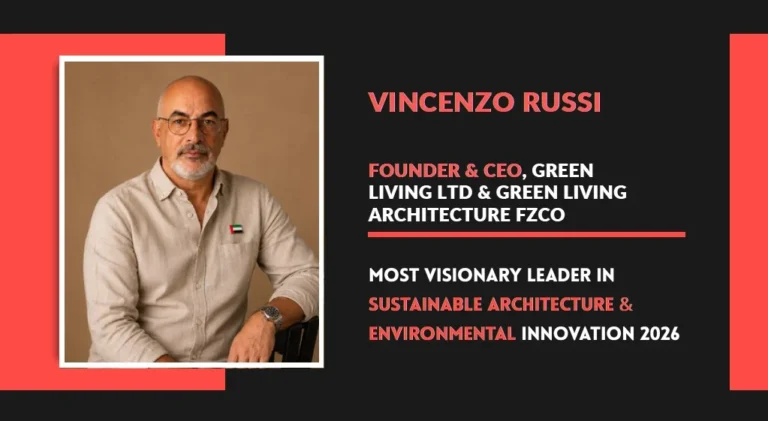
Vincenzo Russi: Redefining Sustainable Architecture Through Innovation and Intelligent Design
A Vision That Turns Industrial Resources into Modern Architecture
When architect Vincenzo Russi founded Green Living Ltd in 2010, he saw an opportunity where others saw a discarded industrial resource. Shipping containers that had completed their role in global logistics could serve a new purpose in architecture, offering a way to rethink construction, reduce material use, and create high-quality living spaces. This idea became the foundation of Green Living Ltd and Green Living Architecture FZCO, two ventures through which Russi has continued to develop a different approach to sustainable building.
His vision grew from three connected concerns: the need to reuse existing resources, the rising cost of construction, and the importance of maintaining architectural quality without making well-designed spaces less accessible. Rather than treating container-based construction as a temporary or low-cost alternative, Russi set out to develop it into a complete building system that combines engineering, design, energy efficiency, and environmental responsibility.
That approach has developed into an international portfolio spanning Europe and the United Arab Emirates. Green Living reports more than 1,200 projects, over 25,000 square meters of designed space, and 128 completed buildings. These projects reflect an approach that extends beyond the reuse of shipping containers. At its core is the belief that construction can be more resource-conscious without limiting the freedom of architectural design.
For Russi, the objective is not simply to build with containers. It is to rethink how buildings are designed, constructed, and operated, making sustainability part of the process from the beginning rather than an additional feature introduced later.
Leadership Rooted in Purpose and Practical Results
Russi’s leadership is shaped by a clear commitment to turning ideas into working solutions. Green Living’s development reflects a willingness to challenge familiar assumptions about construction while addressing the practical requirements of each project. Instead of changing the company’s identity to follow market preferences, he has focused on demonstrating the value of its approach through completed buildings and technical performance.
One example is the Carabinieri station in Ravenna, Italy. The project demonstrates how modular construction can be applied to a public facility with demanding requirements for security, functionality, efficiency, and durability. Its significance lies in showing that a construction method often associated with temporary structures can also serve institutional purposes where reliability and performance are essential.
Green Living has also developed commercial structures, including bars and kiosks for Starbucks, designed to retain a recognizable architectural identity across different locations while incorporating energy-autonomy systems. The company’s work now extends to high-end villas in the United Arab Emirates, where the structural potential of shipping containers is combined with contemporary architectural design.
These projects reveal a leadership approach that places practical evidence above assumptions. Each application provides an opportunity to demonstrate how the system can respond to different needs, from public infrastructure and commercial spaces to private residences. The common thread is the effort to maintain design quality while making construction more efficient and environmentally responsible.
Innovation Beyond the Shipping Container
Green Living’s central innovation lies in how it uses shipping containers. Many container-based buildings preserve the original industrial appearance of the structure. Russi has pursued a different direction, treating the container primarily as a structural component that can be integrated into a wider architectural system.
This approach requires more than arranging and connecting modules. The entire building envelope must be carefully designed to address insulation, thermal bridges, building systems, comfort, safety, spatial planning, and energy performance. Green Living has developed internal and external insulation solutions that allow the structural module to be concealed within a contemporary design. As a result, the building’s external appearance is not restricted by the shape or look of the original container.
The system supports a range of architectural forms, including horizontal and vertical compositions and multistory buildings of up to 10 floors. This flexibility allows projects to respond to their intended use, location, and visual identity rather than forcing every building into the same design.
Russi’s approach also brings energy and water systems into the planning process. Photovoltaic panels, battery storage, and technologies that produce drinking water from atmospheric humidity can be incorporated into the building’s overall design. One example is the Eolo system, which, under suitable operating conditions, can produce approximately 300 liters of water per day.
The importance of this integration is that sustainability becomes a feature of the entire building rather than a collection of separate additions. Structure, insulation, energy generation, and water production are considered together, helping create buildings with the potential to reduce dependence on external utility networks.
Addressing Industry Challenges Through Experience
One of the greatest obstacles facing container-based architecture is public perception. The word “container” often brings to mind temporary accommodation, industrial facilities, or basic structures with limited design possibilities. Changing that perception requires more than presenting an attractive concept. It requires completed projects that demonstrate comfort, durability, safety, and architectural quality.
Russi has addressed this challenge by expanding Green Living’s work across different building types and countries. Its experience includes public facilities and villas in Italy, hospitality structures in Austria, schools in Italy and the United Kingdom, a university campus in Lithuania, and luxury villas in the United Arab Emirates. The variety of these applications demonstrates the system’s ability to respond to different functional requirements and architectural settings.
Technical complexity presents another challenge. Shipping containers were originally designed for transporting goods, not for providing the insulation, indoor comfort, and energy performance expected of modern buildings. Adapting them requires careful engineering and a complete understanding of how the building will function once occupied. Green Living’s emphasis on the building envelope and integrated systems reflects the importance of solving these issues at the design stage.
The company has also had to establish its position in the highly competitive UAE real estate market. Rather than relying only on cost as a selling point, Russi has focused on the combination of technology, architectural quality, and sustainability that distinguishes Green Living’s offering.
His recognition as a Certified Technician by the Italian Chamber of Commerce in the United Arab Emirates marks an important professional milestone. Green Living has also received the Italian Excellence recognition in 2024, 2025, and 2026 and participated in B-CAD events in Sharjah in 2023 and Dubai in 2024 and 2025. These achievements reflect the company’s continuing efforts to build its presence in an international market while retaining its original vision.
Sustainability That Extends Beyond Construction
For Russi, sustainable architecture begins with the responsible use of materials but must continue throughout a building’s operation. Reusing shipping containers gives existing industrial resources another purpose, while the company’s construction approach can reduce the amount of reinforced concrete required compared with conventional building methods.
Industrialized construction also offers opportunities to shorten project timelines. According to Green Living, certain residential building types can be completed within a period of a few months. Shorter construction schedules can reduce the time spent on-site, while the controlled use of prefabricated components can support a more organized building process.
The company’s wider sustainability strategy focuses on improving the relationship between buildings and the resources they consume. Solar power, energy storage, and atmospheric water-generation technology are intended to help buildings operate with greater independence from external networks. In regions facing pressure on energy and water supplies, these systems offer a practical direction for reducing reliance on conventional infrastructure.
However, their effectiveness depends on local conditions, project requirements, and the systems selected for each building. Green Living’s approach therefore emphasizes integration during design, allowing technologies to be considered in relation to the building’s location and intended use.
This focus is particularly relevant to the company’s work in the United Arab Emirates, where environmental conditions create distinct demands for cooling, water supply, and energy management. By combining structural reuse with resource-conscious building systems, Russi is working toward an approach in which environmental responsibility and architectural ambition support one another.
Building a Global Model Without Limiting Design
Green Living’s next stage centers on international expansion. Russi aims to establish the company’s construction system in new markets while allowing it to adapt to different climates, building traditions, functional needs, and architectural preferences. The objective is not to reproduce an identical Italian design in every country, but to establish a flexible construction framework that can support different forms of architecture.
As Russi explains, the ambition is to “industrialise the process without industrialising the architecture.”
The principle captures an important distinction in Green Living’s strategy. Standardized processes and modular construction can improve efficiency, but they do not need to result in buildings that look alike. By separating the structural system from the final architectural expression, the company aims to combine the advantages of industrialized construction with the individuality of good design.
The UAE remains an important part of this development, while the company is also looking toward international opportunities, including Modular Expo in Warsaw and exhibition events in Thailand, South Korea, and China. These efforts form part of a wider ambition to establish reuse-based, prefabricated construction as a model that can be adapted to markets around the world.
Knowledge-sharing is another element of this strategy. Green Living is preparing a technical eBook focused on architecture using shipping containers, accompanied by an international competition offering a villa of approximately 200 square meters as the prize. The initiative is intended to extend the company’s experience beyond individual projects and encourage broader interest in the possibilities of this construction method.
Making Better Buildings a Practical Reality
Russi’s work reflects a wider question facing the construction industry: how can buildings meet modern expectations for comfort, design, and performance while using resources more responsibly? His answer is grounded in the combination of material reuse, engineering, architectural flexibility, and integrated technology.
Green Living’s projects show how a shipping container can become the starting point for buildings that serve very different purposes. The real achievement is not the use of an unconventional structural element alone, but the development of a system that allows it to meet the demands of contemporary architecture.
His philosophy also challenges the idea that sustainability must come at the expense of quality or design. High-end residences, public facilities, commercial structures, and educational buildings can all benefit from approaches that consider efficiency and resource use from the earliest planning stages. Making these benefits accessible across different building types remains an important part of the company’s broader mission.
Russi’s advice to aspiring leaders reflects the same willingness to act before an idea becomes widely accepted: “My advice is not to wait for the future to become inevitable. You need the courage to anticipate it.”
That principle has guided Green Living from its early interest in discarded shipping containers to its growing international portfolio. As the company pursues new markets and develops its integrated approach to building design, its central objective remains consistent: to show that architectural quality, technological progress, environmental responsibility, and affordability do not have to compete with one another.
For Vincenzo Russi, the future of construction is not defined by a single material or technology. It depends on the ability to bring them together in ways that solve real problems. Through Green Living Ltd and Green Living Architecture FZCO, he continues to develop that idea into buildings designed not only to use resources differently, but also to expand what sustainable architecture can achieve.