Joan Gillman
Science Teacher, The Browning School
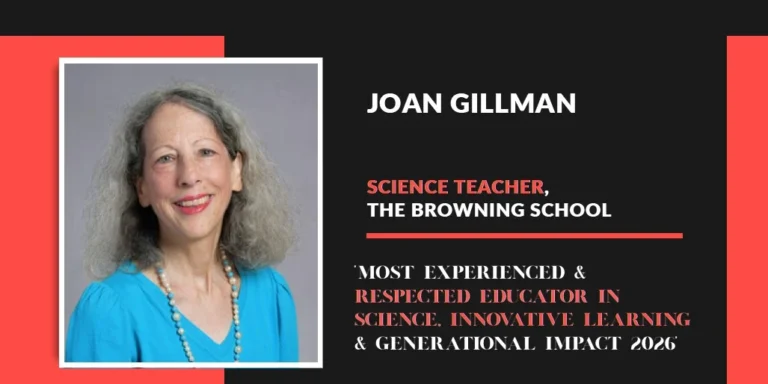
Joan Gillman: Inspiring Young Minds Through Science, Curiosity, and Environmental Action
A Journey Rooted in Curiosity
For Joan Gillman, science has never been limited to textbooks, formulas, or facts to memorize. It begins with a question, an observation, or the simple desire to understand how the world works. As a science teacher at The Browning School, Gillman has built her career around this belief, encouraging students to explore their surroundings, test ideas, and discover how their knowledge can make a difference. Her approach combines hands-on learning, creative teaching, and environmental awareness to help young people become confident learners and responsible members of their communities.
Her interest in science began in childhood. She experimented with different powders and liquids in her bathroom, hoping to develop something new, and carefully measured snowfall, temperature, and barometric pressure during winter storms. She also enjoyed building robots from shoeboxes and creating model cities with her older brother. These early activities gave her opportunities to observe, design, experiment, and solve problems. Looking back, they reflected the same qualities she would later bring into her classroom: curiosity, creativity, and a willingness to learn through experience.
Gillman’s interest in teaching developed during high school, when she volunteered in an elementary school as part of a community service program. She taught recorder, tutored students in mathematics, and organized playground games that included children with different abilities. She also taught swimming to young children, including those with special needs, and worked as a substitute ballet teacher. These experiences helped her understand the value of patience, encouragement, and inclusion. They also shaped a principle that continues to guide her work: every child deserves an opportunity to shine.
Making Science Accessible Through Experience
One of the most influential experiences in Gillman’s professional development came while she was completing her master’s degree in education. As a student teacher at P.S. 47 Junior High School for the Deaf, she worked with students in grades seven through nine. Her cooperating teacher demonstrated how hands-on activities could make complex scientific ideas easier to understand.
During an electronics unit, the students applied what they had learned to build a miniature amusement park with working rides and attractions. The project showed Gillman how practical experiences could help students connect scientific concepts with real outcomes. It became an important lesson in her own teaching practice.
Over the years, she has increasingly used experiments, models, creative assignments, and student presentations to strengthen learning. Rather than relying only on memorization, she encourages students to apply their knowledge by building something, conducting an experiment, developing a model, or explaining a concept to their classmates. Some students may express their understanding through art, while others may be more comfortable preparing presentations or working with materials. Recognizing these different strengths helps create a classroom where students can contribute and learn from one another.
Gillman describes her classroom as a community of learners. In this environment, students are encouraged to work together, respect different perspectives, and help one another succeed. The Browning School’s guiding values of dignity, curiosity, purpose, and honesty support this approach. For Gillman, curiosity should never come at the cost of a student’s confidence. Questions should be welcomed, mistakes should become learning opportunities, and every student should feel comfortable participating.
Turning Environmental Awareness Into Action
As a science teacher and one of the leaders of The Browning School’s K-8 Green Team, Gillman extends learning beyond the classroom. She wants students to understand environmental challenges without feeling overwhelmed by them. Climate change, water shortages, and conservation can seem like enormous problems to young people, but she believes education can help them recognize where their actions matter.
A lesson on water shortages demonstrated how classroom discussions can inspire lasting involvement. While teaching sixth-grade students about access to clean water, Gillman introduced the differences between communities that have reliable supplies and those that do not. One student was particularly moved by the issue and later joined the Green Team. Together, the students researched organizations working to improve access to clean water and chose to support Water.org.
The school community organized a fundraiser, with students creating posters, sharing information, collecting donations, and encouraging others to participate. Their efforts raised more than $1,000. The experience offered a practical lesson in how research, teamwork, and civic responsibility can come together to address a real-world need.
The Green Team has also responded to humanitarian emergencies. Following news that families had lost their homes in Hurricane Melissa, students organized a weeklong fundraiser. They collected donations in the school lobby and concluded the effort with a bake sale. The initiative raised $2,300.32 for Project HOPE and American Friends of Jamaica. For Gillman, the students’ willingness to give their time and energy demonstrated the value of helping young people connect knowledge with compassion.
Environmental responsibility is also built into the school’s everyday routines. The Green Team introduces a weekly Green Action, encouraging students and teachers to adopt practical habits such as switching off unused lights, recycling correctly, and using both sides of a sheet of paper. Students create signs to spread these messages and share environmental information with their homerooms and during school assemblies.
The team also participates in Central Park cleanups, organizes biodiversity challenges, invites guest speakers, and supports environmental and community causes. These activities show students that meaningful change can begin with small decisions and grow through collective effort.
Adapting to Change Without Losing the Human Touch
During a teaching career that began in 1982, Gillman has witnessed major changes in classroom technology. Her early teaching relied on a blackboard and chalk. Today, digital tools such as SmartBoards and Chromebooks allow her students to view videos, examine images, organize notes, complete assignments, and collaborate with classmates.
She has learned to embrace these tools when they improve understanding and make lessons more accessible. Visual presentations, for example, can help students follow information more clearly, while digital resources allow teachers to respond to questions as they arise. Yet her experience has also reinforced the importance of choosing teaching methods according to what students need, rather than adopting technology simply because it is available.
Gillman approaches artificial intelligence with similar care. She recognizes that AI may become increasingly common in education, but she believes it should support learning rather than replace independent thought. Students still need opportunities to write, reason, solve problems, and develop their own ideas. The challenge for educators is to make responsible use of new tools while protecting the skills that students must develop for themselves.
Curriculum development is another important part of her work. As The Browning School moves toward aligning its lower and middle school science courses with the Next Generation Science Standards, Gillman has worked closely with colleagues to update lessons and learning materials. She spent nearly 35 hours revising the kindergarten and fourth-grade science curricula, bringing new expectations into the classroom while maintaining a practical, student-centered approach.
She also supports more interdisciplinary learning, recognizing that science rarely exists in isolation from mathematics, language, art, and other subjects. Connecting these areas can help students understand how knowledge works together beyond school.
Sharing Knowledge Beyond the Classroom
Gillman’s contribution to science education reaches fellow teachers as well as students. She has led workshops at conferences organized by the National Science Teaching Association, the Science Teachers Association of New York State, the Science Council of New York City, STEMTeachersNYC, and other educational organizations. In spring 2024, she also helped plan the SCONYC conference.
Through these opportunities, she shares creative teaching strategies and learns from educators working in different settings. Her role as an Elementary Subject Area Representative for STANYS has also involved organizing online workshops and presenting at annual conferences.
Her writing provides another way to reach teachers. She has contributed articles and educational materials to publications including the STANYS Bulletin and NSTA’s Science and Children. Her curriculum, Straw Rockets are Out of This World, first appeared in Science and Children in 2013 and was later republished in the 2016 book Bringing STEM to the Elementary Classroom. She has also contributed materials to Corwin’s book What Teachers Want to Know About Teaching Climate Change.
These efforts reflect her belief that educators benefit from exchanging ideas and continually improving their practice. By sharing methods that have worked in her classroom, she helps other teachers bring greater creativity and enthusiasm into science education.
Her work has received several forms of recognition, including the Urhy Teacher of the Year award at the Calhoun School in 2017 and the International Association of Top Professionals’ Top Educator of the Year 2025 distinction. Recently, the IAOTP awarded Gillman “Top Educator of the Decade 2026” and their distinguished “Woman of the Year” award. She has also received other professional honors and an honorary doctorate from CICA International University. Although these milestones acknowledge her achievements, she places particular value on the progress her students make and the confidence they develop.
Preparing Students for the Future
As Gillman focuses on teaching science across the lower school, including kindergarten, she remains committed to professional development and curriculum improvement. She plans to continue attending science conferences, learning about new discoveries, and sharing useful approaches with fellow educators. Her ongoing work with the Green Team and professional education networks will allow her to keep supporting students and teachers beyond her daily classes.
Climate change will remain an important part of that mission. Gillman wants students to understand environmental issues well enough to make informed decisions as adults. She also sees a continuing need to balance digital learning with opportunities for students to think independently, write in their own words, and develop practical skills.
Her advice to aspiring educators reflects the lessons of her own career: keep learning, remain patient, maintain a sense of humor, and do not hesitate to seek help from colleagues. Teaching can be demanding, but the opportunity to help students discover their abilities makes the work deeply rewarding.
For Gillman, the lasting value of science education lies in what students do with what they learn. A classroom experiment may spark an interest that grows into a career. A lesson about clean water may inspire a student to support a community initiative. A simple environmental habit may become part of a lifelong commitment to conservation.
By bringing curiosity, inclusion, and practical action together, Joan Gillman shows how science teaching can reach beyond academic achievement. Her work at The Browning School helps students see themselves not simply as learners, but as people capable of asking important questions, caring for their communities, and contributing to a better future.