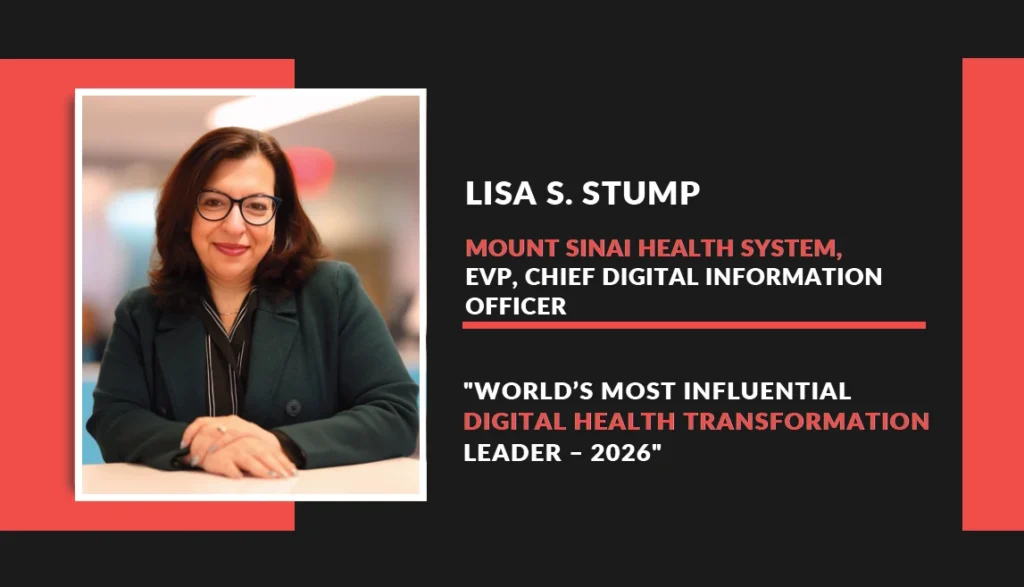
Lisa S. Stump (Mount Sinai Health System) – World’s Most Influential Digital Health Transformation Leader – 2026
Lisa S. Stump EVP, Chief Digital Information Officer at Mount Sinai Health System Lisa S. Stump: Designing the Digital Future of Healthcare With Purpose and Precision Healthcare is one of the most complex industries in the world. Every decision carries high stakes, and every process directly affects patient outcomes. For Lisa S. Stump, EVP and Chief Digital Information Officer at Mount Sinai Health System, this reality has shaped her entire career. Her journey began not in a boardroom but at the bedside, where she witnessed firsthand how systems, processes, and technology could influence patient safety. Early in her career as a clinical pharmacist within a health system, medication orders were handwritten, and safety depended largely on human vigilance. Nurses, pharmacists, and physicians relied heavily on manual checks and memory to prevent errors. While these practices reflected the dedication of healthcare professionals, Stump believed that the system itself could be designed to better support them. She saw the potential for technology to reduce risk and improve care. A pivotal moment early in her leadership journey reinforced that belief. After a routine computer upgrade at her organization, the team noticed a sudden rise in near-miss medication events. Instead of treating the issue as a simple technical glitch, Stump approached it as a clinical problem. As Director of Pharmacy at the time, she gathered a small team and visited patient care units to observe how work was actually being done. What they discovered revealed a deeper issue. Clinicians often had to read information on one screen, write it down manually, and then enter it into another system. The process slowed decision-making and increased the risk of errors. The experience reinforced an important lesson that would shape her leadership philosophy for years to come. The most valuable insights often come from the front lines, and meaningful technology transformation begins by understanding the real challenges clinicians face. Today, as the digital leader for Mount Sinai Health System, Stump remains guided by that same perspective. Her work focuses on building systems that make healthcare safer, simpler, and more effective for clinicians and patients alike. She believes that when technology reduces complexity and cognitive burden, it directly improves safety, care quality, and the experience of everyone involved. Leadership Rooted in Clinical Understanding Stump’s leadership philosophy is grounded in a deep understanding of clinical environments. Having worked directly in patient care early in her career, she approaches digital transformation not as a technical exercise but as a clinical and operational responsibility. She believes that successful healthcare technology initiatives must start with empathy for the people who use them every day. Clinicians operate in fast-paced, high-pressure environments where every second matters. Technology must support their work rather than slow it down. One of the most important lessons she learned early in her leadership journey was the value of observation and listening. By engaging with nurses, physicians, pharmacists, and other frontline professionals, she developed a clear understanding of where technology created friction and where it could remove barriers. That approach has remained central to her leadership style. Rather than designing solutions in isolation, Stump focuses on interdisciplinary collaboration. Clinical experts, technologists, operational leaders, and administrators work together to translate real-world needs into scalable digital solutions. Her philosophy also reflects a broader view of healthcare safety. In her view, safety and experience are closely connected. When clinicians must navigate complicated systems or duplicate work across multiple platforms, the risk of errors increases. By simplifying processes and reducing unnecessary steps, organizations can improve both safety and efficiency. This mindset helped guide the creation of a Clinical Informatics department during her earlier leadership roles. The goal was to bridge the gap between clinical care and information technology by bringing together professionals who could understand both worlds. That effort laid the foundation for many of the large-scale digital transformation initiatives she would lead in the years that followed. Building A Unified Digital Foundation One of the most significant initiatives of Stump’s career was leading the implementation of an enterprise-wide electronic medical record system. At the time, Mount Sinai Health System operated with multiple record systems across hospitals and medical groups. Some locations still relied on paper documentation. While individual sites had developed systems that worked for their local needs, the lack of standardization created fragmentation across the broader health system. Information did not always move easily between facilities, and clinicians often lacked a complete view of patient records. The transition to a unified electronic medical record platform required more than technical execution. It demanded alignment across a complex organization with many stakeholders and perspectives. Stump recognized that success would depend on building a shared vision. She focused on communicating how a common digital platform could improve patient care, enable safer transitions between providers, and create a stronger foundation for data-driven improvement. Listening played an important role in that process. Clinicians and administrators across the system were invited to share their concerns, expectations, and insights. Transparent governance structures helped ensure that decisions were made collaboratively and aligned with the broader mission of the organization. Another key element of the strategy was breaking the project into achievable phases. Rather than approaching the transformation as a single massive undertaking, the work was structured into milestones that teams could complete step by step. An early mentor once offered Stump a piece of advice that continues to guide her work today: moving a mountain requires moving one shovel of dirt at a time. That philosophy helped sustain momentum during one of the most complex digital transformations in the health system’s history. The result was not simply a new technology platform but a stronger foundation for coordinated care, improved data insights, and future innovation. Navigating The Complex Challenges Of Digital Health Healthcare organizations today face rapid technological change, increasing data complexity, and rising expectations from patients and clinicians alike. For Stump, the challenges of digital health extend far beyond the technology itself. One of the most critical issues is the quality and reliability of healthcare data. High-quality data is