Abdulrahman Alonaizan
Chief Business Continuity Officer, Arab National Bank
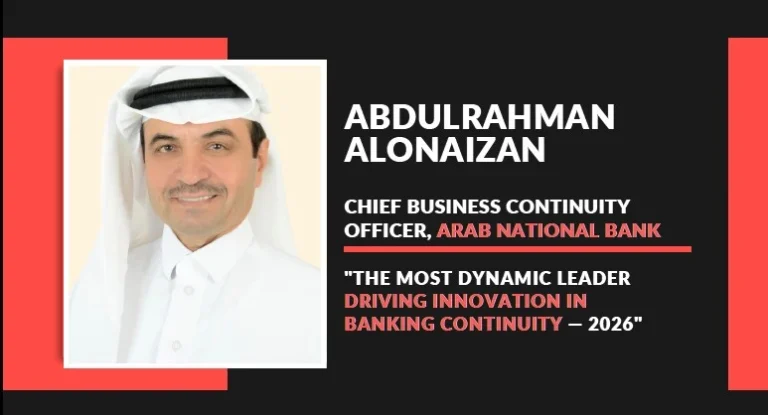
Abdulrahman Alonaizan: Building Resilience Into the Future of Banking
In modern banking, continuity is no longer simply about keeping operations running during a disruption. It is about preparing organizations to respond with confidence, protect customers, support employees, and recover quickly when unexpected events occur. As financial institutions become more connected to technology, digital services, external partners, and changing customer expectations, business continuity has become a strategic responsibility that reaches far beyond traditional risk management.
At Arab National Bank, Abdulrahman Alonaizan, Chief Business Continuity Officer, represents this evolving approach to organizational resilience. His professional journey reflects a clear understanding that continuity must be built into the way an organization operates rather than treated as a response reserved for times of crisis. Through structured planning, collaboration, technology, and a strong focus on preparedness, he works to strengthen the bank’s ability to remain dependable in a changing business environment.
His approach brings together operational discipline and forward-thinking. Rather than viewing business continuity as a collection of plans and procedures, Alonaizan focuses on creating a culture in which resilience becomes part of everyday decision-making.
Leadership Built on Preparedness and Trust
Effective leadership in business continuity requires more than technical knowledge. It requires the ability to bring different teams together around a shared understanding of risk and responsibility. Alonaizan’s leadership style reflects this principle, with an emphasis on communication, accountability, collaboration, and practical preparation.
In a banking environment, continuity depends on many functions working together. Technology, operations, cybersecurity, risk, facilities, human resources, communications, and senior management all have important roles to play when disruption occurs. A successful continuity framework therefore cannot operate in isolation.
Alonaizan encourages an approach where teams understand not only their individual responsibilities but also how their decisions affect the wider organization. This helps create stronger coordination and reduces uncertainty when rapid action becomes necessary.
His perspective can be summed up in a simple principle: “Resilience is not built when a crisis happens. It is built through preparation, awareness, and continuous improvement.”
This philosophy also shapes the way he works with people. Instead of relying only on formal processes, effective leadership involves building trust so that employees understand the importance of preparedness and feel confident in their responsibilities.
Turning Continuity Into a Strategic Function
Business continuity has traditionally been associated with emergency response and recovery planning. Today, its role is much broader. Organizations must consider technology failures, cyber incidents, third-party dependencies, operational interruptions, natural events, regulatory requirements, and other disruptions that can affect critical services.
Alonaizan’s work reflects this wider view of resilience. His focus is on understanding the organization’s critical activities, identifying vulnerabilities, establishing appropriate controls, and ensuring that response arrangements remain practical and current.
This requires continuous assessment. Business environments change, technology evolves, new services are introduced, and customer expectations develop. A continuity plan that was effective several years ago may not provide the same level of protection today.
For that reason, resilience must be treated as an ongoing process. Testing, reviews, exercises, lessons learned, and updates become important tools for strengthening preparedness.
Technology also plays an increasingly important role. Digital platforms can improve visibility, communication, monitoring, and response coordination. At the same time, greater digital dependence introduces new risks. Alonaizan’s approach recognizes both sides of this equation by supporting innovation while keeping resilience and risk awareness at the center.
Navigating Complexity Through Discipline
One of the major challenges in business continuity is that disruption rarely follows a predictable path. A single incident can affect several areas at once, creating operational, technological, financial, and reputational consequences.
For financial institutions, the stakes are particularly high. Customers depend on uninterrupted access to essential services, while regulators and stakeholders expect strong controls and reliable governance. This makes preparedness a critical part of maintaining trust.
Alonaizan’s work involves addressing this complexity through structure and disciplined planning. Clear priorities, defined responsibilities, tested procedures, and strong communication can help organizations respond more effectively when circumstances change.
The journey toward stronger resilience is also marked by milestones that are not always visible from outside the organization. Successful exercises, improved response times, stronger cross-functional coordination, updated plans, and greater employee awareness all contribute to long-term resilience.
These achievements demonstrate an important reality about continuity leadership: success is often measured by what does not happen. When preparation works, disruption can be contained before it becomes a larger business problem.
Preparing for the Next Generation of Risk
Looking ahead, resilience will become increasingly connected to digital transformation. Artificial intelligence, automation, cloud services, data-driven operations, and interconnected platforms are creating new opportunities for financial institutions. They are also creating new dependencies that must be understood and managed.
For Alonaizan, the future of continuity involves staying ahead of these changes rather than responding to them after they occur. This means continually examining how new technologies affect critical operations and ensuring that resilience frameworks evolve alongside them.
The future also calls for stronger integration between business continuity, operational resilience, cybersecurity, enterprise risk management, and crisis management. These areas cannot be treated as completely separate disciplines when a single event can affect all of them simultaneously.
A forward-looking continuity strategy therefore requires both technology and people. Advanced systems can provide valuable support, but effective response still depends on clear leadership, trained employees, strong communication, and timely decisions.
Alonaizan’s vision reflects this balance. The objective is not simply to create stronger recovery plans, but to develop an organization that can adapt, respond, and continue serving its stakeholders under changing conditions.
Creating Impact Beyond the Organization
The importance of business continuity extends beyond internal operations. In banking, resilience supports customers, businesses, employees, partners, and the broader financial ecosystem.
When essential banking services remain dependable during difficult circumstances, customers experience greater confidence. Businesses can continue their own operations, employees can remain connected to critical functions, and stakeholders can rely on the institution to fulfill its responsibilities.
This wider impact gives continuity leadership a strategic dimension. It is ultimately about protecting trust.
Alonaizan’s contribution to this field is rooted in that understanding. By promoting preparedness, collaboration, structured risk thinking, and continuous improvement, he helps position business continuity as an essential part of modern banking leadership.
His journey also reflects the changing nature of the profession itself. The Chief Business Continuity Officer is no longer simply responsible for maintaining documents or coordinating emergency exercises. The role increasingly involves shaping organizational resilience, supporting strategic decisions, understanding emerging risks, and helping organizations prepare for uncertainty.
At Arab National Bank, Alonaizan brings this broader perspective to his role. His work demonstrates how resilience can become a source of organizational strength when it is built into culture, governance, technology, and daily operations.
In a business environment where change is constant and disruption can take many forms, preparedness offers something valuable: confidence in the ability to respond. For Abdulrahman Alonaizan, that confidence comes from disciplined planning, engaged people, continuous learning, and a clear commitment to keeping the organization ready for what comes next.