Eric Sternberger
Media Producer, Infocus Multimedia
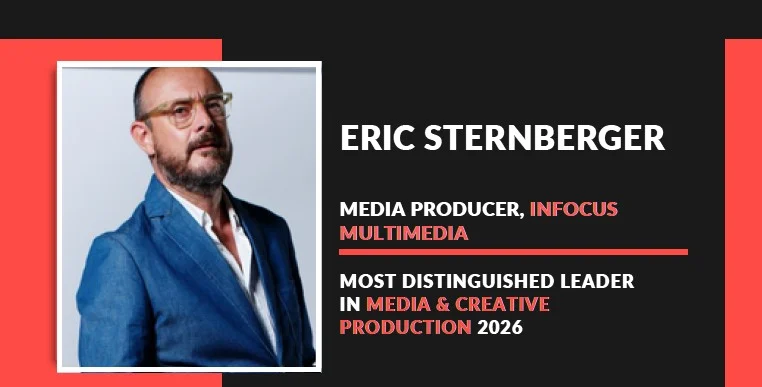
Eric Sternberger: Where Technology Meets the Human Story
Sometimes the most useful lessons in a career happen when things do not go according to plan. For Eric Sternberger, one of those moments came in China in 2001. He had traveled to Yunnan Province on a DAAD scholarship to produce a documentary about indigenous communities. His role was familiar: observe, ask questions, listen, and turn what he found into a story. Then he was unexpectedly cast in a Chinese movie. For someone used to working behind the camera, suddenly becoming the person in front of it was a strange shift. He experienced what it meant to be observed and interpreted by someone else, and the experience changed the way he approached storytelling. Before deciding how a story should be presented, he learned to look at it from different angles and consider how it might feel to the person being represented.
That way of thinking has followed him through a career that has changed along with the media industry. Today, as Media Producer at Infocus Multimedia, Sternberger works across storytelling, technology, and creative production. He has seen production methods evolve dramatically and has embraced new tools, including generative AI. But the technology has not changed what interests him most. People still make the story worth telling. Technology can make production faster and open new creative doors, but it cannot replace the human reason for telling a story in the first place.
Managing Creativity in the Age of AI
Sternberger gives creative people room to think. That approach matters in an industry where new ideas can easily become constrained by deadlines, budgets, established processes, or the assumption that something has always been done a certain way. He is comfortable with a certain amount of friction because someone questioning an idea or suggesting a different approach can be where the better idea begins. Generative AI brought that attitude into sharper focus. When AI began moving quickly into creative industries, there was understandable concern about what it might mean for writers, filmmakers, designers, producers, and other creative professionals. Sternberger did not ignore those concerns, but he also did not want fear to prevent his team from exploring the technology. He encouraged experimentation.
Rather than asking whether AI could replace creative people, he focused on how it could help them. Some repetitive work could be reduced, ideas could be explored more quickly, and early concepts could be tested before a production team committed significant time and resources. That gives people more room to concentrate on the decisions that actually shape a story. It also reflects the way Sternberger approaches leadership. He does not need to be the person with every answer. He wants people around him who are willing to challenge an idea, try something different, and learn from the result.
Why Empathy Outpaces Algorithms
Sternberger approaches generative AI pragmatically. Tools that accelerate brainstorming, planning, and rapid prototyping serve as a “sparring partner,” helping creative teams test ideas and explore possibilities before committing to expensive production decisions. But speed alone does not make a story better. AI can generate images and ideas, yet it lacks the personal experience, empathy, and nuanced judgment that come from years of observing real people and their stories.
As content becomes easier to produce, the real challenge is deciding what deserves to be created and whose voice deserves to be heard. For Sternberger, AI can expand the creative process, but the responsibility for making those decisions remains with the people telling the story.
From Cardiac Catheters to Captivating TV
Sternberger has spent much of his career making subjects accessible without stripping away what makes them interesting. A significant milestone came in 2013, when he received the Science in TV and New Media Award for a program about the development of the first cardiac catheter. It was an achievement that brought together several things central to his work: science, research, communication, and storytelling. Scientific subjects can be difficult to bring to a broad audience because they often involve complex processes and specialist knowledge. The challenge is not simply to explain the subject correctly, but to give people a reason to stay interested. Sternberger understands that distinction. The story behind an invention or discovery often begins with a problem someone was trying to solve. There are people involved, decisions to be made, setbacks to overcome, and consequences that extend far beyond the laboratory. Finding those human elements can make even a highly technical subject understandable and engaging.
His documentary background has reinforced that approach. Documentary filmmaking requires patience. It means listening carefully, researching thoroughly, and spending enough time with a subject to understand what is really happening rather than relying on the first impression. It also requires trust, particularly when real people are allowing a filmmaker into their lives. That combination of accuracy and empathy has remained important throughout Sternberger’s work.
Impact Through Authentic Representation
For Sternberger, the responsibility of a producer starts before production begins. It starts with deciding which stories are worth telling. He looks for projects that create genuine value for the organizations involved while also offering something meaningful to the wider community. Once a project is chosen, the challenge becomes representation: making sure the people and communities at the center of the story are not reduced to convenient characters in someone else’s narrative. Local voices matter because people who live within a community understand its details, history, and challenges in ways an outside production team may not. Bringing those perspectives into the process can make a story more accurate and give it greater credibility.
Media has a way of shaping what audiences think they know. A documentary, television program, or other production can influence how people see a community, a scientific development, an industry, or an issue. Sternberger takes that responsibility seriously. A production should work technically, but that is only part of the job. The people appearing in it should feel that their experiences have been treated with honesty and respect.
From Fact to Fiction: Taking Documentary Instincts to Scripted TV
Sternberger is now taking his experience in documentary filmmaking into scripted television. He is developing a fictional television series based on real-world research and authentic human perspectives. The project gives him an opportunity to bring the observation and research that shaped his documentary work into a fictional format, while discussions with major streaming platforms, including Netflix and HBO, are already underway. The move makes sense when viewed against the rest of his career. Documentary filmmaking taught Sternberger to pay attention to people, behavior, environments, and the small details that make a situation believable. Those same instincts can help build convincing characters and stories in fiction.
There is also a personal element to the transition. After spending years documenting reality, fiction offers a different kind of creative freedom. It allows him to take what he has learned from real experiences and develop those ideas in a different setting. He is not leaving documentary storytelling behind. He is taking its lessons with him. That willingness to move into unfamiliar territory has become increasingly valuable in media, where formats change quickly, audiences move between platforms, and technology continues to alter the production process. Staying relevant means being willing to learn again, even after years of experience.
The Discipline Behind Creativity
For all the attention given to new technology, Sternberger’s advice to people entering the creative industry is refreshingly straightforward: work hard and respect the craft. The finished production is usually the part audiences see. They do not see the revisions, failed ideas, technical problems, long conversations, late nights, or decisions that had to be revisited along the way. Sternberger knows that creative work is rarely as effortless as it looks. An idea can be exciting on day one and much harder to execute several weeks later. That is where discipline becomes important. Creative freedom is valuable, but someone still has to turn the idea into something finished.
He also places importance on collaboration. Good production rarely comes from one person working in isolation. It depends on people bringing different skills and perspectives to the same project and being willing to listen to one another. For Sternberger, there is no contradiction between freedom and discipline. A team can experiment while still being accountable for the result.
A Future Built Around Better Stories
Sternberger’s career has taken him from documenting indigenous communities in China to producing science programming, exploring AI, and developing scripted television. Each experience has brought a different perspective to his work, but his interest in people and the stories they have to tell remains constant.
As new technologies reshape media production, Sternberger continues to explore what they make possible without losing sight of what gives a story its meaning. His experience in front of the camera taught him to consider the person being represented. Documentary filmmaking sharpened his ability to observe and listen, while his work with scientific subjects showed him how to make complex ideas accessible.
Now, as he explores new creative formats, those lessons continue to inform his work. The tools may change, but the real work lies in finding stories worth telling and giving them the attention, honesty, and human perspective they deserve.