Juan Intan Kanggrawan
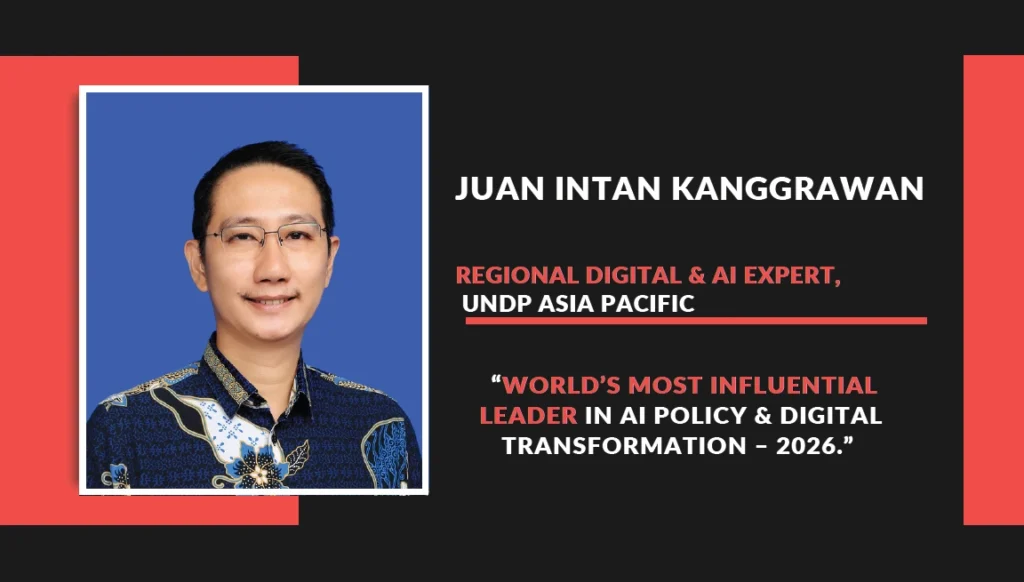
Juan Intan Kanggrawan
World’s Most Influential Leader in AI Policy & Digital Transformation – 2026
In an age when digital transformation is shaping economies, societies, and how governments serve their people, a new generation of leaders is redefining how technology can create meaningful public impact. Among them is Juan Intan Kanggrawan, Regional Digital & AI Expert at UNDP Asia Pacific. His work sits at the intersection of policy, technology, and public service, where artificial intelligence, data, and digital systems become tools for better governance and stronger communities.
Over more than 15 years of experience in government, global development, and technology, Kanggrawan has helped design and implement digital transformation strategies that have affected millions of people. From shaping data-driven policies in Indonesia to building regional AI platforms for the Asia Pacific, his work reflects a clear belief that technology must serve people first.
Kanggrawan’s journey has not followed a single traditional path. Instead, it reflects the evolving nature of leadership in the digital age. His career spans roles in global organizations, government initiatives, and major technology-driven programs. Through each stage, he has focused on one central mission. Technology should solve real problems and create systems that are transparent, effective, and inclusive.
Today, his leadership at UNDP Asia Pacific focuses on helping governments and institutions adopt responsible AI and digital systems that support sustainable development. His work supports policymakers, researchers, and institutions across the region, ensuring that data and technology become reliable foundations for decision-making.
Recognition has followed his influence. In 2026, he was honored with the title “World’s Most Influential Leader in AI Policy & Digital Transformation,” a reflection of the impact his work has created across multiple sectors. Yet behind the recognition is a leader who remains focused on a simple principle. Digital transformation is not about technology alone. It is about people, trust, and long-term societal value.
Early Influences and a Defining Moment
Every leader has a moment that changes the direction of their journey. For Kanggrawan, that moment came through an experience rooted in volunteer work rather than formal leadership.
During 2014 and 2015, while he was in Singapore, he volunteered in technology initiatives that supported government programs and the Ministry of Infocomm. The experience exposed him to how digital systems could improve the way governments operate and deliver services.
Reflecting on that time, he explains, “I helped the government of Singapore and the Ministry of Infocomm in some digital initiatives. It widened my horizon about the beauty and impact of technology in the public sector.”
The experience shifted his perspective. Technology was no longer just a professional field. It became a powerful instrument for social impact and governance reform.
From that point forward, Kanggrawan focused his work on connecting data science, digital policy, and public sector innovation. His goal was to build systems that allow governments to make smarter decisions while delivering better services to citizens.
A Career Built Across Public and Digital Transformation
Over the past decade and a half, Kanggrawan has built a career that combines strategy, technology, and policy leadership. His work has influenced organizations across both public and private sectors, including Fortune 500 companies and G20 governments.
Before joining UNDP Asia Pacific, he held leadership roles in major digital initiatives in Indonesia and Singapore. He served as Head of Data and Digital Products at Jakarta Smart City and GovTech Indonesia, where he helped develop data-driven systems to improve urban governance.
In those roles, he led teams that combined expertise from many disciplines. Strategy, engineering, policy, research, economics, and product development came together to build solutions that could support large-scale transformation.
He also previously served as Head of Data Products at Traveloka in Singapore, where he contributed to building data infrastructure that supported large technology platforms.
Through these roles, Kanggrawan developed a rare combination of capabilities. He understands the technical side of data systems and artificial intelligence, but he also understands the complexity of public policy and institutional decision-making.
This combination allows him to act as a bridge between technology teams and policymakers. It is a skill that has become increasingly important in the modern digital era.
Today, as a Regional Digital & AI Expert at UNDP Asia Pacific, he works across multiple countries to guide digital transformation initiatives, promote responsible AI use, and support governments in creating data-driven strategies.
Leadership Philosophy: Building Change Through Collaboration
Leadership in digital transformation is rarely about one individual. It requires collaboration across disciplines, organizations, and institutions. Kanggrawan’s leadership style reflects this reality.
Throughout his career, he has built and led teams composed of professionals from many fields. Engineers, economists, researchers, product designers, and policy experts often work together within these projects.
His approach is built on the idea that innovation happens when diverse expertise comes together around a shared goal.
Instead of focusing only on technical achievements, Kanggrawan encourages teams to think about the broader impact of their work. Every solution must address real societal needs and deliver measurable outcomes.
He often focuses on building environments where teams can experiment, learn, and iterate quickly. In complex digital projects, solutions rarely appear perfectly on the first attempt. Progress requires learning from data, adapting strategies, and continuously improving systems.
This leadership philosophy also emphasizes practical results. Digital transformation should not remain a theoretical concept. It must translate into working platforms, functioning systems, and services that people can use.
By aligning technology with practical impact, Kanggrawan ensures that innovation remains connected to real-world needs.
Driving Innovation Through Data and AI
Artificial intelligence and data analytics are becoming central tools in modern governance. Governments today must analyze large volumes of information to understand complex social and economic challenges.
Kanggrawan’s work focuses on turning these technologies into practical decision-making tools for policymakers.
One of the initiatives that best reflects his vision is the development of an AI platform for policy sense-making within the Asia Pacific region.
The platform helps governments and institutions interpret large datasets and extract insights that support policy decisions. By organizing complex information into accessible knowledge, the system enables leaders to better understand trends, risks, and opportunities.
In many governments, data exists but is scattered across multiple systems. Without integration, it becomes difficult to translate information into action. Kanggrawan’s work addresses this challenge by designing platforms that bring data together into structured ecosystems.
Another major example of his innovation strategy can be seen in his work with Indonesia’s Ministry of Education.
Through this initiative, Kanggrawan and his team helped integrate reliable data ecosystems that allow policymakers to make more informed decisions about education systems.
Education policy requires understanding student performance, institutional resources, regional disparities, and long-term development goals. By building integrated data platforms, governments can analyze these factors more effectively and design policies that produce better outcomes.
He explains that these systems aim to ensure decisions are based on accurate and reliable information rather than assumptions.
Transforming Cities Through Smart Technology
Urban environments present unique challenges. Cities must manage transportation, public services, safety, infrastructure, and environmental sustainability.
During his time with Jakarta Smart City, Kanggrawan helped design digital systems that improved how the city responded to these complex demands.
One of the major initiatives involved predictive urban analytics. By analyzing city data, authorities could anticipate patterns such as traffic congestion, public service needs, and environmental risks.
This allowed city leaders to move from reactive responses to proactive planning.
Another key innovation was the development of a citizen-focused digital platform often referred to as a SuperApp for Jakarta residents.
The platform integrated multiple public services into a single digital interface, allowing citizens to access government services more easily.
Through such systems, digital transformation moves beyond internal government operations and becomes a direct tool for improving daily life.
Citizens benefit from faster services, improved communication with government agencies, and more transparent governance.
Projects like these demonstrate how data and AI can transform cities into more responsive and efficient environments.
Navigating Challenges in Digital Transformation
Despite the promise of technology, digital transformation is rarely simple. Governments and institutions often face structural and cultural barriers when introducing new systems.
For Kanggrawan, one of the most significant challenges lies in organizational resistance to change.
He notes that many institutions struggle with what he describes as “unwillingness to change.”
In such environments, even the most advanced technology can fail if organizations are not ready to adapt.
To overcome this challenge, Kanggrawan focuses on identifying and empowering individuals within institutions who are open to innovation.
He explains, “I need to find good change agents and ensure there are short-term tangible impacts. Positive changes can then be done progressively.”
This strategy allows transformation to begin with smaller successes that demonstrate value. Once institutions see clear benefits, broader adoption becomes easier.
Another challenge lies in balancing innovation with responsible governance. Artificial intelligence systems must be transparent, ethical, and accountable. Policymakers must ensure that technology benefits society without creating unintended risks.
Kanggrawan’s work emphasizes responsible AI frameworks that ensure fairness, transparency, and trust in digital systems.
By addressing both technological and institutional challenges, he helps organizations adopt innovation in sustainable ways.
Milestones That Reflect Real Impact
Across his career, Kanggrawan has received multiple global recognitions as an innovator, data leader, and AI policy expert. Yet when asked about the most meaningful milestone in his journey, he does not focus on awards or professional recognition.
Instead, he points to a moment during the COVID-19 pandemic when digital systems played a critical role in delivering services to communities.
During that period, digital platforms helped provide targeted and reliable information and services to citizens who needed support.
Reflecting on the experience, he explains that the urgency and intensity of the situation made the impact especially meaningful.
“Providing targeted and reliable digital services during the COVID-19 period was very memorable,” he says. “The urgency and intensity of the impact made it highly meaningful.”
Moments like these reveal the real purpose behind digital transformation. Technology becomes valuable not when it is impressive, but when it helps people during difficult times.
For Kanggrawan, such experiences reinforce the importance of building resilient digital infrastructure that can support societies during crises.
Ensuring Long-Term Impact
In the world of technology innovation, trends often change quickly. New tools appear, gain attention, and sometimes disappear within a few years.
Kanggrawan believes that meaningful digital transformation requires looking beyond temporary trends.
His approach focuses on identifying fundamental problems and addressing them with long-term solutions.
He explains that true impact comes from understanding the root causes of challenges rather than following superficial trends.
“By deeply reflecting on the core or foundational problem, not only following hype or superficial trends, the impact will be real and long-lasting,” he says.
This philosophy guides many of the projects he leads.
Rather than implementing technology simply because it is new, he encourages organizations to ask deeper questions. What problem are we solving? How will this system improve lives? How will it remain useful in the future?
By keeping these questions at the center of digital strategy, Kanggrawan ensures that innovation remains purposeful.
A Vision for the Future of AI in Governance
Looking ahead, the role of artificial intelligence in governance will continue to grow. Governments must process increasingly complex information while addressing global challenges such as climate change, economic inequality, and rapid urbanization.
Kanggrawan believes AI can help policymakers navigate these complexities, but only if it is used responsibly.
His vision involves building AI systems that act as decision support tools rather than replacements for human judgment.
In this model, AI analyzes large datasets, identifies patterns, and presents insights that help policymakers understand complex issues. Human leaders then interpret those insights within social, ethical, and political contexts.
This partnership between human judgment and machine intelligence can significantly improve governance outcomes.
Kanggrawan also emphasizes the importance of regional collaboration. Countries across the Asia Pacific region face many similar challenges, from climate risks to digital infrastructure development.
By sharing knowledge, data practices, and technological frameworks, governments can accelerate progress together.
Through his work at UNDP Asia Pacific, he continues to support such collaborative efforts across borders.
Influence Beyond Technology
While much of Kanggrawan’s work centers on digital systems, his influence extends beyond technology itself.
He is also actively involved in academic research, thought leadership, and community engagement.
He contributes to research initiatives and discussions that explore the broader societal implications of AI and digital transformation. His work encourages policymakers, researchers, and technology leaders to consider ethical and philosophical questions surrounding innovation.
This intellectual engagement reflects his belief that technology must be guided by strong values and thoughtful governance.
In addition to his professional roles, Kanggrawan is also a passionate volunteer in initiatives that support social and educational development.
His work in teaching, mentoring, and public dialogue reflects his commitment to building future generations of digital leaders.
Through these efforts, he continues to expand the conversation around responsible technology and inclusive innovation.
A Leader Shaping the Digital Future
The digital era requires leaders who understand both technology and society. Artificial intelligence, data analytics, and digital platforms have enormous potential, but their true value depends on how they are implemented.
Juan Intan Kanggrawan represents a leadership model that combines technical expertise with policy insight and human-centered thinking.
From early volunteer work in Singapore to global initiatives with UNDP Asia Pacific, his journey reflects the power of purpose-driven innovation.
His work demonstrates that digital transformation is not simply about adopting new tools. It is about building systems that empower governments, strengthen communities, and create opportunities for future generations.
As the world continues to navigate the opportunities and challenges of the digital age, leaders like Kanggrawan will play an important role in shaping how technology serves society.
Through thoughtful strategy, collaborative leadership, and a commitment to long-term impact, he continues to help define what responsible digital transformation looks like in the twenty-first century.
And in doing so, he reminds us that the true measure of technological progress lies not in algorithms or platforms, but in the positive change they create for people and communities around the world.