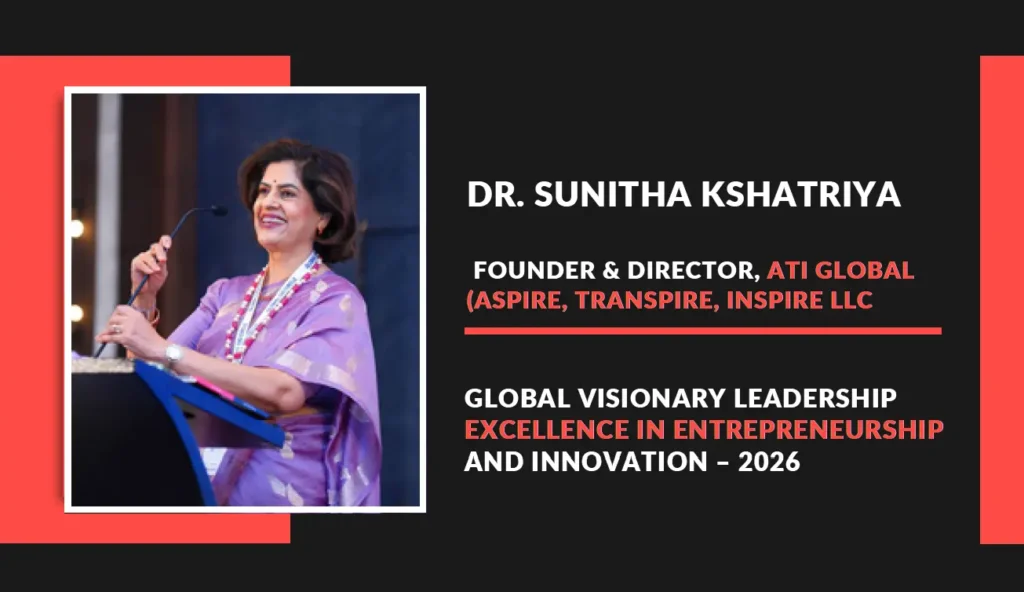
Dr. Sunitha Kshatriya (ATI Global (Aspire, Transpire, Inspire LLC)) – Global Visionary Leadership Excellence in Entrepreneurship and Innovation – 2026
Dr. Sunitha Kshatriya Founder & Director of ATI Global (Aspire, Transpire, Inspire LLC) Building Bridges Between Leadership, Entrepreneurship and Innovation Across Canada, the UAE, Saudi Arabia, India and a growing network of global collaborations, Dr. Sunitha Kshatriya has built her career around one enduring idea: potential flourishes when people are connected to the right knowledge, relationships, capital and opportunities. Leadership Rooted in Purpose and People For Dr. Kshatriya, leadership begins with values rather than titles. Integrity, empathy, purpose and long-term relationships form the foundation of how she leads people and builds partnerships. Her work across academia, industry, government and entrepreneurship has reinforced a simple conviction: leadership is not about possessing every answer; it is about bringing the right people together, asking better questions and creating conditions in which others can succeed. That philosophy was shaped early in Canada. After relocating there in 2008, she saw highly qualified immigrant women struggle to rebuild their professional identities because their experience and transferable skills were not readily recognised. She responded by developing an empowerment programme for women aged 35 to 50 through Skills for Change. The initiative received support through Status of Women Canada and became a turning point in her journey, later informing her TEDx talk, academic research, books on empowerment and her first not-for-profit initiative, eCAFE. “Leadership is about creating environments where other people can succeed.” Innovation With a Human Purpose Innovation is central to ATI Global, but Dr. Kshatriya does not treat technology as a complete answer. Artificial intelligence, blockchain, sustainability and digital transformation are reshaping how organisations operate; their value, she argues, depends on whether they solve meaningful human problems and are applied with ethics, imagination and purpose. This belief deepened in 2018, when the UAE Ministry of Higher Education selected her from among 200 faculty members for a fully funded programme at Stanford University’s d.school. Design thinking gave formal language to an approach she had already begun to practise: start with empathy, understand the people behind the problem and then move from insight to experimentation and action. ATI Global carries this human-centred approach into its work by connecting entrepreneurs with investors, mentors, universities, governments, corporations and markets. The aim is not simply to produce more ideas, but to help promising ideas acquire the support, discipline and pathways required to become sustainable ventures. From Institution Builder to Global Ecosystem Architect At the American University in Dubai, Dr. Kshatriya helped build the Entrepreneurship and Innovation Center from the ground up. Over six years, the ecosystem supported more than 500 startup ideas and ventures, delivered over 350 workshops, enabled 73+ startup trade licences and connected entrepreneurs with a network of more than 150 mentors. It also facilitated funding pathways exceeding AED 500,000 and developed extensive partnerships across the wider innovation community. The centre’s structured pathway—spanning foundation, mindset, ideation, incubation, acceleration and partner programmes—reflected her belief that entrepreneurship support must extend beyond isolated workshops. Founders need a coherent journey from understanding a problem to testing an idea, building capability, accessing markets and becoming investment-ready. Her regional work also included designing entrepreneurship programmes with PwC Academy Middle East for Saudi Arabia, linking entrepreneurship education with workforce transformation. These experiences strengthened her capacity to translate ideas across cultures and to convene education, industry, government, investors and founders around shared outcomes. ATI Global: Aspire, Transpire, Inspire After leaving the American University in Dubai in December 2025, Dr. Kshatriya founded Aspire, Transpire, Inspire LLC—ATI Global—in February 2026. Based in the UAE and building international corridors across the GCC, India, North America and beyond, the organisation represents the natural convergence of nearly two decades of work in education, research, entrepreneurship and ecosystem development. Its name captures the journey she seeks to enable: aspire to a larger possibility, transpire through disciplined action and lived experience, and inspire others through impact. ATI Global’s methodology combines design thinking, entrepreneurial ecosystems, experiential learning, strategic partnerships and human-centred leadership. Together, these elements connect talent, knowledge, capital, technology and opportunity rather than treating any one of them as sufficient on its own. “The greatest breakthroughs rarely begin with technology; they begin with understanding people.” Turning Reinvention Into Strength Some of the most defining milestones in Dr. Kshatriya’s career began as disruption. Moving from India to Canada required rebuilding her professional identity. Returning to Dubai opened a new chapter in higher education and ecosystem building. The later transition from institutional leadership to entrepreneurship brought her experience in corporate life, research, teaching, mentorship and innovation into one global platform. These transitions taught her that a single approach cannot work in every country, market or institution. Adaptability, cultural intelligence and the willingness to learn continuously are essential. They also reinforced two principles that shape her leadership today: resilience matters more than perfection, and relationships matter more than titles. A Vision for the Next Generation Dr. Kshatriya expects the next decade to demand a more integrated form of capability. Technical knowledge will remain important, but it will need to be complemented by curiosity, creative confidence, systems thinking, emotional intelligence, ethical judgement, resilience and the ability to collaborate across cultures and disciplines. She encourages emerging leaders not to wait until they feel completely prepared. Progress often comes through action: testing assumptions, inviting feedback, learning from failure and adjusting with humility. Her practical guidance is direct—remain curious, embrace uncertainty, build relationships before you need them, never stop learning and help others succeed. “The future belongs to organisations that learn faster than the pace of change.” Impact Measured in People For Dr. Kshatriya, awards and milestones matter most when they reflect the growth of others. The deeper reward is seeing students, founders and professionals gain confidence, launch ventures and redirect their lives because a mentor, programme or partnership made opportunity visible. The recognition of Global Visionary Leadership Excellence in Entrepreneurship and Innovation – 2026 reflects the breadth of that contribution. More importantly, it honours a leadership journey grounded in a lasting principle: meaningful success is created when innovation opens doors for people, strengthens communities and enables opportunity to extend